Stair lift installation requirements
Stair lift installation requirements are fewer than most people expect: no major building work, no wall to fix to and no strengthening, makers say. What a fitting does need is a nearby socket, treads to fix the rail to, and room to get on and off at each end. Here is each requirement as the makers state it.
Checked against the sources at the foot of this page on 13 November 2026. Stairlift Fitters is published by SEO Dons Ltd, which fits nothing itself.
In short
A socket usually within about 10 feet of the top or bottom of the stairs; treads to fix the rail to (no wall needed, no strengthening); room at each end to get on and off; and enough width and head clearance. That is Stannah’s list. Any work needed first, such as fitting a socket, is done before the fitting day.
Power
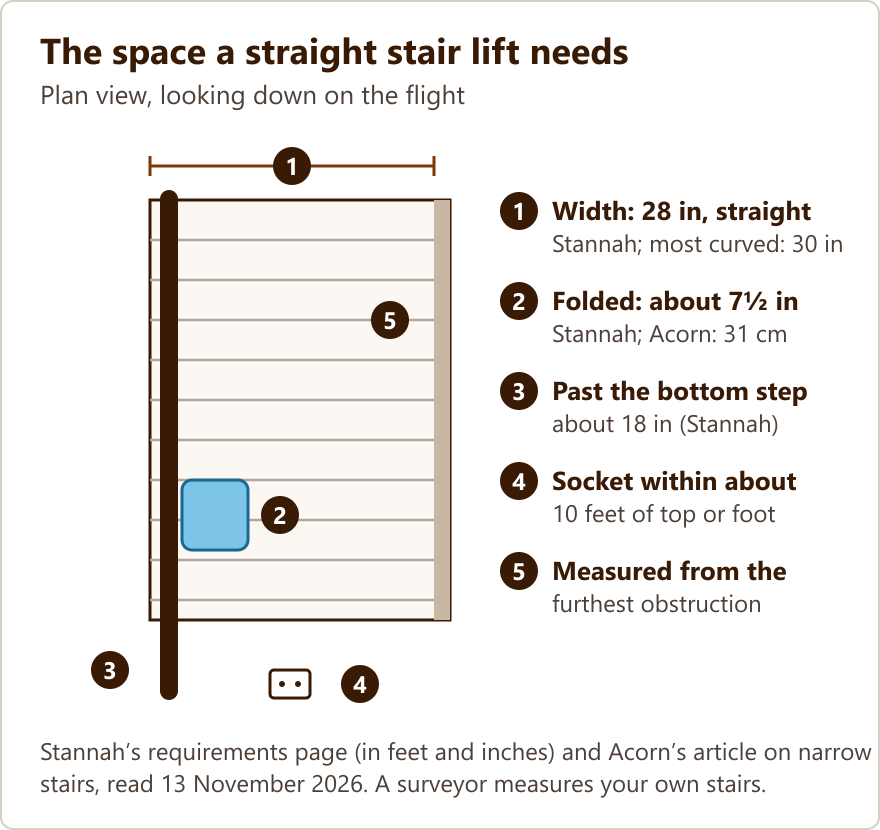
Stair lifts run on batteries charged from the mains. Stannah says you need a nearby socket, usually within about 10 feet of the top or bottom of the stairs, which charges the batteries and keeps the lift running during a power cut. It provides trunking to keep cables neat, but if there is no socket near the stairs, an electrician has to fit one. Which? notes that work like an extra power point adds time before fitting, and that an outdoor lift needs an electricity supply that meets installation safety requirements.
Electrical work is for an electrician
This site gives no wiring instructions. Fitting a socket is a job for a qualified electrician, arranged before the stair lift firm arrives.
Fixings
The rail fixes to the stairs, not the wall. Stannah says this is why no remodelling is needed and why a wall beside the stairs is not required, and that treads are made to carry the weight without strengthening. Age UK Trading says brackets are screwed to the treads, two to five screws each, through the carpet; Stannah says its lifts go on carpet, hardwood, cement and metal treads, and that taking a lift out later leaves only a few small screw holes. Acorn and Brooks also say their rails fit to the stairs.
Access at each end
The chair has to start and finish somewhere safe. Stannah says a standard rail runs about 18 inches past the bottom step, so furniture, a door or an open hall at the foot matters; it offers a retractable rail for a door. At the top, its surveyor checks there is room for the chair to swivel so you can get off safely, and adjusts the lift if a door is in the way.
Width and headroom
Stannah gives 28 inches as a typical minimum width for a straight lift, from the furthest obstruction, and says head clearance is rarely a problem except on some basement stairs. Both are measured at the survey: see the survey record.
Handrails and other fittings
Stannah says handrails should be on the wall opposite the lift. If one is in the way, it removes it, but someone else must refit it. Where alterations are needed first, such as moving a radiator, Stannah says it can arrange them and include them in its quote.
What you do not need
- No major building work, Stannah says, because the lift sits on the treads.
- No wall beside the stairs.
- No strengthening of the treads.
- No particular stair covering: carpet or bare wood both suit, Stannah says.
The full list of space figures is on dimensions and space; whether your staircase can take a lift at all is on fitting any stairs; and the rules that apply are on stair lift regulations.
Makers’ pages opened on 13 November 2026.
Questions about installation requirements
What power supply does a stair lift need?
A normal socket nearby. Stannah says one is usually needed within about 10 feet of the top or bottom of the stairs; it charges the batteries and keeps the lift running through a power cut. If there is no socket, Stannah says an electrician fits one.
Does a stair lift need a solid wall?
No. Stannah says its lifts attach to the stair treads, not the wall, so a wall beside the stairs is not needed. Acorn and Brooks also say their rails fit to the stairs.
Does a stair lift need to be plugged in all the time?
It runs on batteries that are charged from the mains. Stannah says the socket charges the batteries and keeps the lift working during a power cut; Acorn says its lift keeps working through a power cut too.
Will my stairs need strengthening?
Stannah says no: treads are made to carry a lot of weight, so they need no reinforcing or changes before fitting.
Sources behind this page
What this page says about a firm, a register or a rule rests on the pages below, each opened on the date given. Firms reword their pages, so confirm anything important with them directly. How each source was chosen and checked is explained on sources and checks.
- Stair lift installation requirements (Stannah) Opened 13 November 2026. Used for: socket, width, space at each end, head clearance, which side, handrails, fixings. No date on the page; it uses feet and inches and talks of outlets and licensed contractors.
- Stairlift installation process (Stannah) Opened 13 November 2026. Used for: the steps from first call to fitting day, and the hours on the day. No date on the page.
- Bespoke stairlift installation (Acorn Stairlifts) Opened 13 November 2026. Used for: who arrives, the tests after fitting, the walk-through, the hours on the day. No date on the page.
- Acorn 180 curved stairlift (specification) (Acorn Stairlifts) Opened 13 November 2026. Used for: the standards it says the lift is tested to, folded width. No date on the page.
- Stairlifts from Brooks (home page) (Brooks Stairlifts) Opened 13 November 2026. Used for: a maker that says its rail is attached to the stairs, not the wall. No date on the page.
- Stairlift installation (Age UK Trading) Opened 13 November 2026. Used for: how Handicare’s technicians fit the lifts Age UK Trading sells, and what is left behind. No date on the page.
- Buying and installing a stairlift (buying guide) (Which?) Opened 13 November 2026. Used for: the surveyor’s visit, getting more than one quote, the wait of one to 14 days, what to check on a used lift. Date on the page: updated 24 August 2026.
Ask what your stairs would need
Mention the nearest socket and anything at the top or bottom of the stairs. We reply by email.
After you send it
- Your request goes to SEO Dons Ltd, the publisher of this site.
- Someone there reads it and answers by email.
- Any next step is your choice. Nothing is booked for you.